

In May 2020, the British government borrowed £3.75 billion from investors for three years.
Nothing particularly unusual about that.
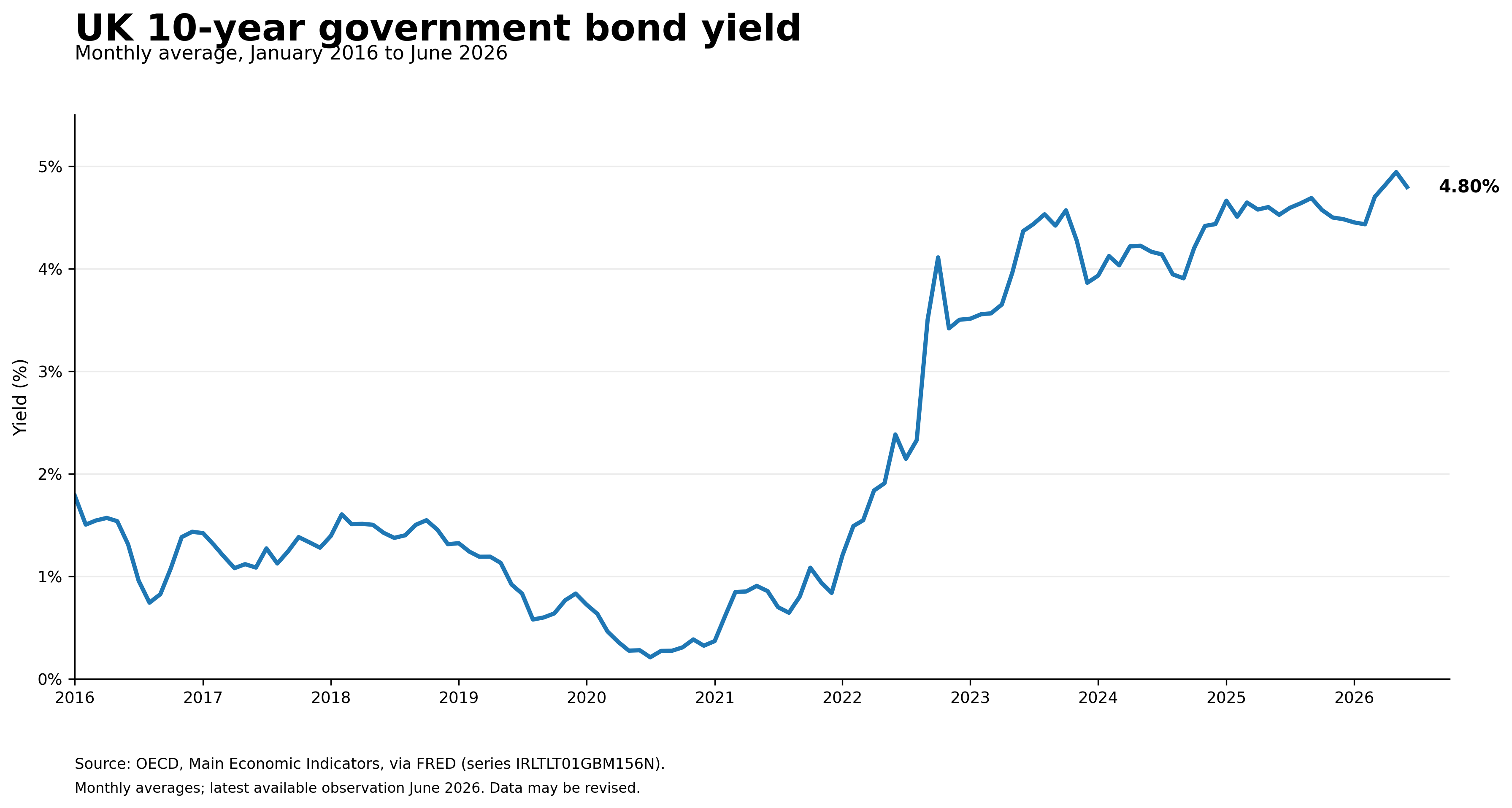
What was unusual was the price. For the first time in history, the UK sold conventional government bonds at a negative yield. Investors were effectively agreeing to receive slightly less money back than they had lent, provided they held the bonds until maturity.
It sounds absurd. Yet the auction attracted plenty of buyers.
At the time, the world was in lockdown. Investors wanted safety, central banks were buying bonds in enormous quantities, and interest rates had been driven towards zero. In that environment, accepting a tiny guaranteed loss could seem preferable to taking an unknown risk elsewhere.
Less than six years later, the bond market looks completely different.
Today, high-quality UK government bonds offer yields of around 5%. The journey from almost nothing to 5% has been painful for existing bondholders. But it may also have quietly restored bonds’ ability to perform the role for which investors own them.
A bond is essentially a loan.
Governments and companies borrow money from investors and agree to pay interest before returning the capital at a predetermined date.
For investors, the importance of bonds is less about their scale and more about the job they can perform within a diversified portfolio.
Shares are usually the principal engine of long-term investment growth.
Investors expect higher returns from equities because company profits are uncertain and share prices can fall sharply. That volatility is not an accidental flaw in equity investing. It is part of the reason investors have historically received higher long-term returns than they could have earned from cash.
The role of high-quality bonds is different.
They can provide a relatively predictable source of income, preserve capital more reliably than equities and, during many periods of stock-market stress, help soften portfolio losses.
Nevertheless, over long periods, bonds and equities have responded differently to changes in economic conditions. Combining them can therefore make the overall investment journey less dependent on one particular outcome.
The problem was not that bonds suddenly stopped being bonds.
The problem was the price investors were paying for them.
Following the global financial crisis, central banks reduced interest rates and introduced quantitative easing. Under QE, central banks created money to purchase government bonds, increasing demand and pushing bond prices upwards.
As bond prices rose, their yields fell.
This relationship is fundamental to understanding what happened next: bond prices and bond yields move in opposite directions.
Imagine owning a bond that pays £10 of annual interest. If comparable new bonds suddenly pay £50, nobody will pay full price for yours. Its market price must fall until the income it provides becomes competitive.
That is broadly what happened when inflation returned and central banks increased interest rates.
New bonds were issued with much more attractive yields. Older bonds paying very little became less valuable, and their prices fell. The longer the time remaining before a bond matured, the more sensitive its price generally was to the change.
It was an uncomfortable adjustment. But it was also the mechanism through which the bond market moved from an extraordinarily low-yielding environment back towards something more normal.
A properly diversified portfolio will nearly always have something underperforming; that is not a flaw, it is the point.
Abandoning an investment after a difficult period can also mean abandoning it at precisely the point when its future prospects have improved.
The yield available when an investor purchases a high-quality bond provides a useful indication of the return they may receive over the bond’s life.
Vanguard’s research describes the starting yield as one of the strongest predictors of a bond portfolio’s subsequent long-term return. This makes intuitive sense. The higher the income locked in at the outset, the less dependent the investor becomes on further changes in the bond’s market price.
That does not mean bond returns will be exactly 5% each year. Prices will continue to fluctuate as inflation, interest rates and economic expectations change.
However, a portfolio beginning with yields of 4% or 5% has a considerably firmer foundation than one beginning with yields close to zero.
Vanguard’s 2026 capital-market forecasts, for example, estimate an annualised return of approximately 5.5% from UK government bonds over the following decade. Forecasts are not promises, but the improvement from the ultra-low-yield era is substantial.
As bonds currently held within a diversified fund reach maturity, their proceeds can also be reinvested into new bonds offering higher rates of interest. Over time, this can progressively increase the income generated by the portfolio.
There are legitimate reasons not to become complacent.
Government debt is high across most major economies. Ageing populations, healthcare costs, defence spending and the interest payable on existing debts will place further pressure on public finances.
The UK also plans to issue a significant quantity of new government debt during the 2026–27 financial year, which may require yields to remain attractive to investors.
There is therefore no guarantee that bond prices will rise from here. If inflation remains persistent or investors become more concerned about government finances, yields could increase further and existing bond prices could fall again.
But the comparison with 2020 is important.
Then, investors accepted almost no return for the same risks. Today, they are being paid considerably more for accepting those risks.
Higher yields do not remove uncertainty. They provide greater compensation for it.
The case for bonds is not that they are about to outperform everything else.
Nor is it that they will protect investors during every period of equity-market volatility.
It is more measured than that.
For much of the decade following the financial crisis, bonds were being asked to provide income and portfolio protection while offering historically meagre yields. The painful adjustment of recent years has changed those starting conditions.
Bonds now generate meaningful income. They have more scope to appreciate if interest rates fall during a future economic slowdown, and the returns available from holding high-quality debt to maturity are more attractive than they have been for many years.
In 2020, investors paid the British government for the privilege of lending it money.
Today, the government must pay them around 5%.
That does not make bonds exciting. But excitement was never their job.
Their job is to provide income, diversification and a steadier counterweight to the inevitable volatility of equities.
For the first time in a long time, they may once again be properly equipped to do it.

Copy here introducing the client stories section and examples of testimonials
