

How should you use your private practice profits

Your private practice company has made a profit. Some of the money could support school fees or mortgage payments. Some could go towards retirement, while some may be needed by the business itself.
Salary, dividends, employer pension contributions and retained profits can each have a place. The useful starting point is what you need the money to do, when you need access and how the proposed payment fits alongside NHS income.
A small salary followed by dividends may remain appropriate. It should emerge from that assessment, rather than determine the plan before the household’s needs are clear.
This article concerns a UK limited company and a UK-resident consultant. Sole traders and partnerships require a different assessment.
Establish what the company can actually provide
Begin with the accounts and a cash forecast. Turnover is not profit, and the bank balance is not automatically available for personal spending. Allow for practice costs, tax liabilities, outstanding bills and the operating reserve the company needs.
Then distinguish available cash from profits legally available for dividends. Dividends cannot exceed the company’s available profits, and they are not deductible business costs for Corporation Tax.
The accountant should establish both the legal position and the cash available before the household plan relies on a payment.
Match the route to the purpose
School fees due next term require accessible money after personal tax. Retirement saving may allow a longer commitment. Funds reserved for practice costs need to remain available to the business.
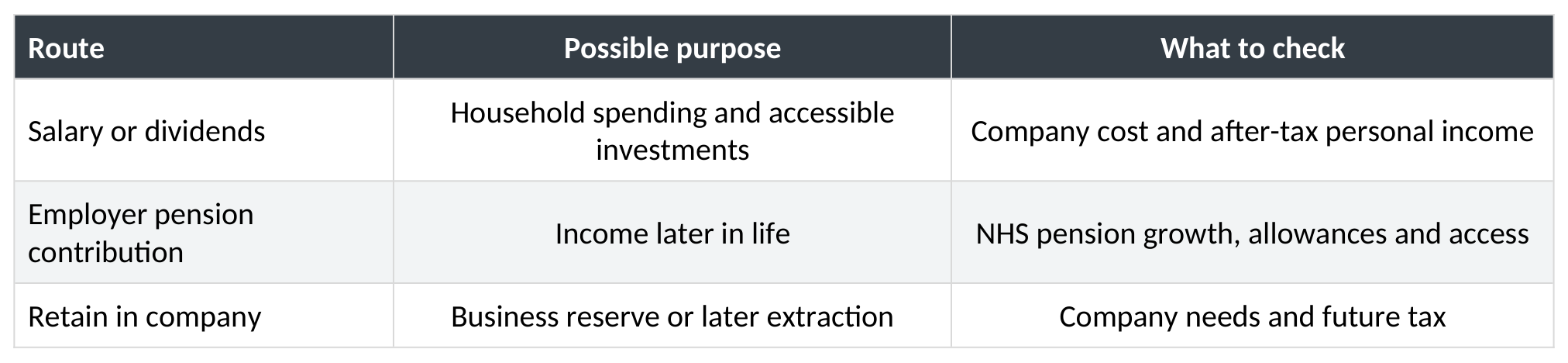
Compare routes from the same starting point: what the company spends, the taxes and costs arising, and what reaches the household or pension. A £20,000 dividend and a £20,000 employer pension contribution do not deliver the same spending power or access.
Avoid committing the same money to several purposes. A reserve for a tax bill cannot also fund a family holiday, and a pension payment cannot cover near-term spending if the pension is not accessible.
NHS income changes the salary and dividend calculation
For 2026/27, dividend tax rates above the £500 dividend allowance are 10.75%, 35.75% and 39.35%, depending on the applicable band. Dividends are considered alongside other income in determining the tax due.
A consultant whose NHS earnings already use the lower bands cannot assess private-company dividends as though the company were their only income source. The personal tax bill is additional to Corporation Tax already due on company profits.
Salary has its own Income Tax, employee and employer National Insurance, payroll and deductibility considerations. Ask the accountant to compare the full cost of the proposed mix, including available reliefs and the effects of having more than one employment. There is no single salary figure that suits every consultant.
A pension contribution answers a different need
An employer contribution to a registered pension is worth comparing for money genuinely intended for later life. Corporation Tax deductibility depends on the business-purpose rules, and the company’s payment does not bypass the individual pension tax assessment.
NHS benefit growth counts alongside other pension saving for the annual allowance. The relevant NHS figure is calculated pension input, not simply the deductions on your payslip. Check tapering, eligible carry forward and any restriction arising from earlier flexible pension access before choosing an amount.
The detailed contribution calculation should sit alongside the extraction strategy. A payment that works for company tax may still create a personal annual allowance charge or leave too little accessible money for plans before retirement.
Retaining profits preserves a later choice
Leaving money in the company can support its operating reserve or allow personal extraction at another time. That may be relevant if NHS or private income is expected to fall as work reduces.
It does not remove tax permanently. Company profits remain subject to Corporation Tax as applicable, and future extraction needs its own assessment. If the money is invested, include the company’s investment taxes, charges and risks, as well as how and when the household could receive the proceeds.
Substantial investment activity can also affect future trading-company and disposal-relief questions. Review that separately as clinical work changes; do not assume eventual winding-up will produce a particular tax outcome.
Include your partner’s circumstances without treating their unused tax bands as automatically available. Salary should reflect genuine work and appropriate remuneration. Dividends depend on share ownership and rights. Have proposed arrangements checked before changing them.
Agree a strategy that changes with the work
Ask the accountant and planner to use the same company figures, income assumptions and household spending needs. A three-to-five-year comparison should show what needs extracting now, what could support retirement and what should remain in the business.
Then test the changes already under consideration. If school fees end, does the household still need the same dividend? If NHS work reduces, what income must the company replace? If private clinics fall away, what happens to the business reserve and future extraction plan?
Review the figures before significant payments and when commitments change. The outcome should be a clear route from company profits to the life they are intended to support, with the tax and access consequences understood at each stage.
This article provides general information, not individual tax, pension or investment advice. Tax figures are for 2026/27 and were checked on 26 October 2026. Company and personal treatment depend on your circumstances.
Let’s talk about what matters to you
An initial conversation, at no cost to you.

London
EC2A 2BX


Ralated Blogs
Copy here introducing the client stories section and examples of testimonials
Your company can change without you investing another penny

Check NHS pension growth before your company contributes
Is leaving your personal pension untouched still the right plan