

There is a moment after markets fall when most investors pause and ask:
“If my portfolio has fallen, does the plan still work?”
It’s a reasonable question. When markets fall, we instinctively focus on what’s visible:
It quickly feels like something has been lost.
In the emotion of it, we often forget that the plan can improve at exactly the moment it feels most uncomfortable.
That’s the part that most investors miss.
If you buy an asset at a higher price, your future return is lower. Buy the same asset at a lower price, and your future return improves.
This relationship has been observed repeatedly across markets and time.
You see it in equity markets globally, and in bonds through yield-to-maturity.
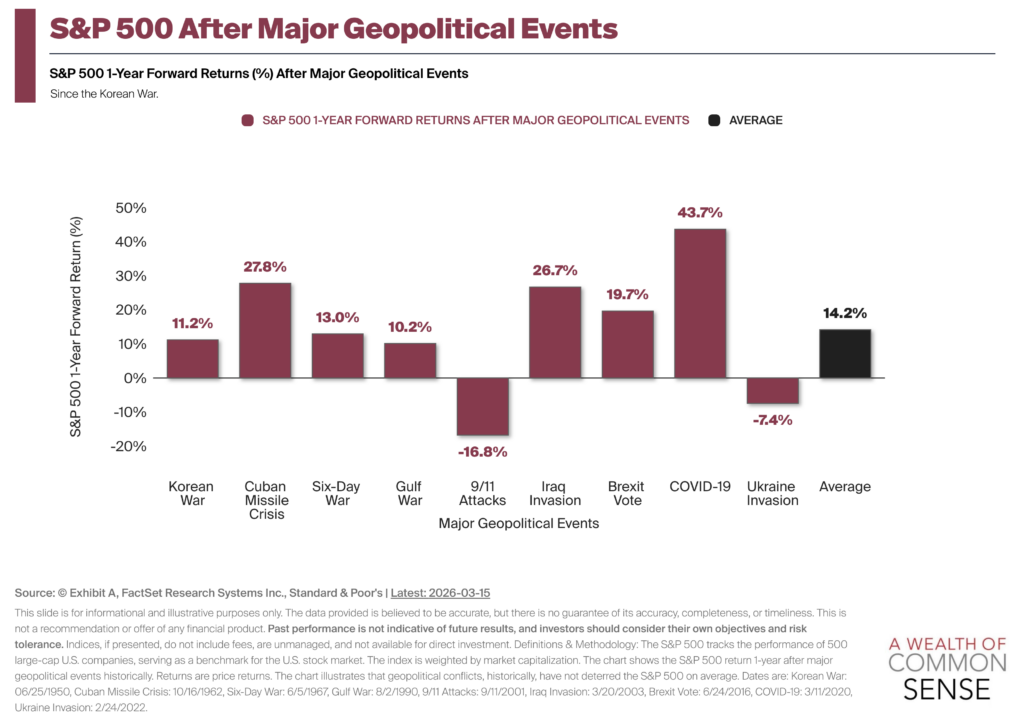
A recent blog by A Wealth of Common Sense illustrates this well.
The principle is simple:
Future returns are largely a function of the starting price.
Historically, periods that feel most uncertain have been followed by strong forward returns.
After the 2008 financial crisis, global equities went on to deliver one of the strongest decades in modern history. There are many other examples.
After these periods, valuations reset — and with them, expected returns improve.
Your WealthMap plan isn’t built on today’s valuation. It’s built on what your capital is expected to earn over time.
And that expectation adjusts.
So when markets fall:
Within a Navigate Portfolio, this isn’t something we react to — it’s built into the structure.
As markets fall:
This isn’t tactical. It’s systematic.
Over time, this leads to a simple outcome:
You accumulate more returns when it’s available at a better price.
Here’s the part that matters most — what feels worse now often leads to better outcomes later.
When markets fall, it feels like risk has increased and the plan is weakening.
But in many cases, expected returns have improved, and the forward position of the plan has strengthened.
This inversion is why investors who act on instinct often do the wrong thing at precisely the wrong time.
A robust financial plan is not built on smooth markets.
It assumes:
These are not disruptions to the system, they are part of how it works.
When markets fall, it rarely feels like an opportunity.
But in many cases, that is exactly what it is.
The real question isn't whether your plan is still working, it is whether you are still in a position to benefit from what has just improved.

Copy here introducing the client stories section and examples of testimonials
