

Could your next RSU vest trigger a UK pension tax bill?

Your salary has not changed. Neither have the regular payments into your pension. Then a substantial award of employer shares vests, and the pension saving that looked comfortably within your allowance needs another calculation.
For an American working in London, a UK-taxable restricted stock unit, or RSU, vest can affect more than the tax deducted from the shares. It can increase the income used to calculate the tapered pension annual allowance. The allowance may fall even though the pension contributions stay the same.
That does not automatically mean a tax charge. The result depends on your full-year income, pension saving and any eligible unused allowance from earlier years. It is a reason to review the vest alongside the pension before treating the proceeds as available for other plans.
Why share income can affect pension saving
RSUs can create UK employment income when shares are delivered at vesting. HMRC’s RSU examples illustrate the treatment. Keeping the shares rather than selling them does not, by itself, prevent that income charge. The precise timing and UK-taxable amount depend on the award and your circumstances.
For 2026/27, the standard pension annual allowance is £60,000. It applies across relevant pension saving, rather than giving you a separate allowance for each pension.
For a defined contribution pension, contributions from you and your employer count, including tax relief added where applicable. Defined benefit pensions require a calculation of benefit growth instead. A lower allowance can apply in some circumstances, including after certain flexible pension withdrawals.
Two income calculations determine whether the taper applies
For 2026/27, the taper applies when both conditions are met: threshold income is above £200,000 and adjusted income is above £260,000.
The allowance falls by £1 for every £2 of adjusted income above £260,000, to a minimum of £10,000. If threshold income is £200,000 or less, the taper does not apply, whatever the adjusted income.
These are defined tax calculations. Salary alone is not enough: bonuses, taxable share awards and other income can matter. Adjusted income normally includes employer pension contributions. Personal contributions and salary sacrifice need their correct treatment; increasing a pension payment does not necessarily undo the taper.
The same pension saving with a smaller allowance
Consider an illustrative executive earning a £200,000 salary. They contribute £10,000 to a UK registered defined contribution pension through a net pay arrangement, meaning it is deducted before Income Tax. Their employer contributes £20,000.
Compare the same 2026/27 tax year with and without a £120,000 RSU vest, assumed to be fully taxable as UK employment income. Assume no other income, deductions, salary sacrifice or defined benefit accrual, and no previous flexible access triggering the money purchase annual allowance.
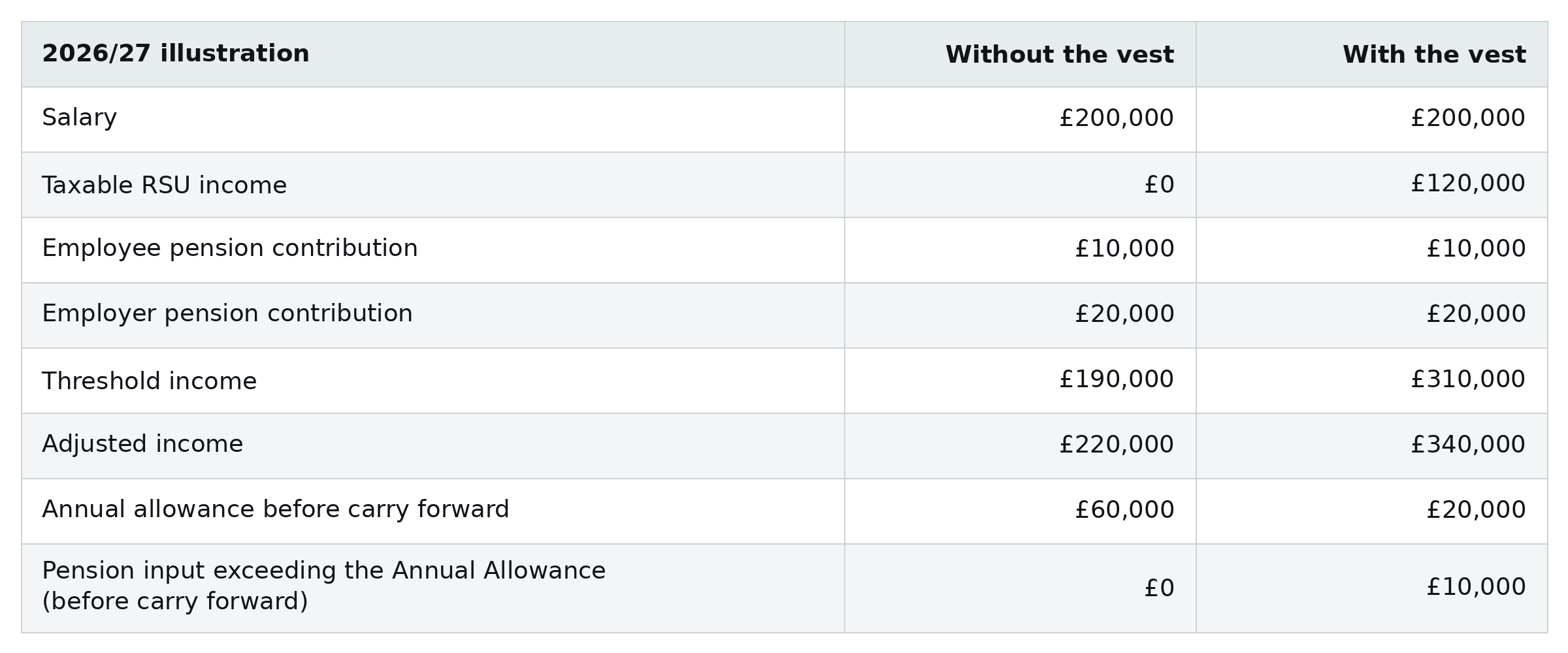
Using HMRC’s calculation rules, threshold income with the vest is £200,000 less £10,000, plus £120,000: £310,000. Adjusted income adds back the £10,000 net pay contribution and includes the £20,000 employer payment, giving £340,000.
That is £80,000 above the adjusted-income threshold. The taper reduces the allowance by £40,000, leaving £20,000 against pension saving of £30,000.
The resulting £10,000 is the excess before carry forward, not the tax bill. If there is no eligible carry forward and the whole excess is charged at 45%, the annual allowance charge would be £4,500. The actual charge depends on the applicable tax rates and circumstances.
Earlier unused allowance may cover the excess
You may be able to carry forward unused allowance from the previous three tax years. For 2026/27, these are 2023/24, 2024/25 and 2025/26. Use the current year’s allowance first, then the oldest eligible unused allowance.
The calculation needs each year’s actual allowance, including any taper, pension saving across relevant schemes and any carry forward already used. In the example, £10,000 of eligible unused allowance would cover the excess.
For someone who recently moved from America, earlier scheme membership matters. Membership of a UK registered scheme generally qualifies; certain non-UK arrangements can qualify under specific conditions. Do not assume that a US retirement account automatically creates unused UK allowance.
Carry forward does not increase the money purchase annual allowance if that applies, or override separate limits on tax relief for personal contributions.
Review the vest before changing contributions
Bring the award schedule, estimated taxable vest values, full-year income and pension records into one calculation. Include the employer’s expected payments and any UK–US work history relevant to the award.
Model different share values if the eventual vesting amount is uncertain. Then compare the available choices. Reducing contributions could mean losing employer matching or saving less for retirement; avoiding a charge is not the only consideration.
If a charge remains, establish how it must be reported and paid. Tax withheld through payroll on the RSU vest should not be assumed to cover a separate pension annual allowance charge. As an American, obtain coordinated UK and US advice before changing pension arrangements; UK treatment does not establish the US result.
The useful number is the amount the vest leaves available after the relevant liabilities have been assessed. Reviewing pension saving alongside the award helps establish that before the money is committed elsewhere.
This article provides general information, not individual pension or tax advice. Rules stated are for 2026/27 and were checked on 26 October 2026. The example is hypothetical. Obtain appropriately qualified UK and US advice before acting.
Let’s talk about what matters to you
An initial conversation, at no cost to you.

London
EC2A 2BX


More Blog Posts
Copy here introducing the client stories section and examples of testimonials
The £300,000 waiting for an answer

What Americans need to know about PFICs before investing UK cash
Buying in London while keeping your US home